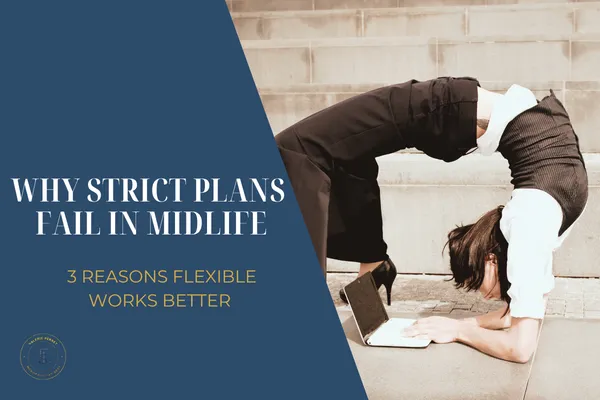
Why Strict Plans Fail in Midlife: 3 Reasons Flexible Works Better
Your body is not a business project.
You've spent years being rewarded for doing things properly. Follow the plan. Stick to the schedule. Don't make excuses. Push through when things get hard.
And when your body starts behaving differently in midlife, it's tempting to assume you need to become even more disciplined.
But here's the problem: your body isn't a business project. You can't always solve changing needs by demanding more from the same system.
If you're exhausted by mid-afternoon, struggling with weight around your middle and finding it harder to concentrate, following a stricter plan is probably not the answer.
💡And if the thought of being flexible makes you worry you'll lose control, I want to show you why flexibility might be the very thing that helps you get consistent results.
In this post, I'll explain why being more flexible with your health doesn’t mean giving up, why the strategies that worked in your younger years may need adjusting now, and how to build an approach that works with your body rather than constantly fighting it.
My goal isn’t to convince you to invest in a programme you don’t need. It’s to help you make a clear, informed decision about what your body needs now.
Let’s look at why flexibility might be the missing piece.
🔍 Why flexibility feels like a risk when you’ve built your life on discipline
Think about how you got to where you are today.
You probably didn’t achieve your professional success by waiting to feel motivated. You showed up when you were tired. You met deadlines, solved problems, made difficult decisions and kept going when things got complicated.
You learned to be reliable even when life wasn't convenient.
Over time, discipline became more than something you did. It became part of who you are.
So when your body starts behaving differently, it's natural to reach for the tool you know best: more control.
You tighten the rules. You try to eat more perfectly. You tell yourself you need to exercise harder or cut out more foods. You reach for another coffee when your energy dips because you still have meetings to get through and people depending on you.
And when those strategies don't work, you assume you need to be even more disciplined.
But there's something important to recognise here.
When your old strategy stops working, it doesn't automatically mean you're failing. It means the strategy needs to change.
This can be particularly relevant in midlife for several reasons.
Hormonal changes during perimenopause and menopause can affect sleep, body composition, recovery and how you experience stress. Ageing, changing routines, reduced muscle mass, medications and other health factors can also influence your energy and metabolism.
Meanwhile, the world around you hasn't necessarily become any less demanding.
Corporate culture still rewards output. Diet culture continues to sell strict rules, quick fixes and 30-day challenges. You may even have worked with a coach in the past who handed you a rigid meal plan and expected you to follow it regardless of what was happening in your life.
And caffeine? It's so normalised as a performance tool that many women barely question how often they rely on it.
😓If everyone around you is telling you to push harder, and every health plan you've seen seems to demand more control, it's understandable that flexibility might sound like the wrong answer.
But let's look at what happens when you begin to see things differently.
1. The rules didn't fail. The body they were built for changed.
One of the most frustrating experiences in midlife is doing everything you believe you're supposed to do and still not getting the results you want.
Despite eating carefully, staying active, trying to get enough sleep and doing your best to manage stress, your pants don’t fit, your energy is unreliable, and your mind goes blank when you need it most.
It's easy to turn that frustration inward. It’s easy to ask: “What’s wrong with me?”
This is where a different starting point makes all the difference.
Midlife hormonal shifts mean the routines you once tolerated no longer work. This is what I call the Menopause Magnifier:
🔎 Five late nights in your thirties and you recovered quickly over the weekend. Now? That same week leaves you depleted for several days. Have you got the picture?
Your recovery needs have changed. Your health habits deserve attention.
If you keep eating less and feel exhausted. If your intense workout takes more out of you than it gives back. Repeating the same approach, even with more determination, is not the answer.
You need to look at the results you're getting and adjust accordingly.
Let go of the "How can I stick to this?" and ask, “Does it actually help me?”
A symptom is not proof that you lack discipline; it’s information that can help you make better decisions.
And if your energy, sleep, or weight changes are persistent or concerning, it's worth exploring possible causes with your health care professional rather than assuming everything is hormonal.
You don't need to punish your body for changing. You need to understand what it's telling you.
2. You're already flexible.
Here's something I suspect you don't give yourself enough credit for.
You probably make flexible decisions every single day.
At work, you reprioritise when an urgent problem appears. You adjust your communication style depending on the person in front of you. You change your plans when new information comes to light.
Adapting your approach makes you more effective. So why should your health be any different?
Athletes' training plans include different levels of effort, recovery and adjustments based on how they're responding. Recovery is part of the plan. Your health needs a similar balance.
⚡This is particularly relevant when it comes to metabolic flexibility. Your body has an intrinsic ability to switch between different fuel sources according to what’s available and what it needs.
Your nutrition, physical activity, sleep, and overall energy availability influence the switch. There is no point in maintaining a single fuel source all the time. This flexibility between the two supports your metabolic health, and it happens through your lifestyle.
☕ This is also relevant when you reach for caffeine to get through the day. Caffeine temporarily increases alertness and reduces the feeling of fatigue, but it doesn't replace sleep or address every reason you're tired.
If your afternoon energy depends on another coffee just to get through the next meeting, that pattern deserves some attention.
💭 It’s time to explore what might help: adequate meals, hydration, movement, rest, a different routine or addressing depleting emotions.
You don’t need to abandon structure. You need to adapt the structure when your circumstances change. Reaching your goals doesn't mean every day, week, or month looks identical.
You didn't get to where you are by being rigid about everything. You got here by learning, adapting and making decisions. Your health requires the same intelligence.
3. Rigid is fragile. Flexible is durable.
Have you ever started a new health plan on a Monday, followed it perfectly for several days, then watched the whole thing unravel when life got busy?
Perhaps a work deadline appeared. Someone in your family needed extra support. You slept badly for three nights, or you simply had a day when you didn't have the energy to do everything on your list.
You missed a workout. Your meals weren't what you'd planned. You reached for convenience instead of following your usual routine.
And suddenly, it felt like you'd ruined everything. And you told yourself you'd start again later.
🔁 This is the exhausting cycle of all-or-nothing thinking: follow the plan perfectly, fall off the plan, feel disappointed, and start over.
The problem isn't your commitment. The problem is that the plan has no room for being human.
When a strategy only works if you have a perfect week, it isn't particularly well suited to a life filled with responsibilities.
And for a woman who manages a team, supports her family and carries a mental list of a hundred things that need doing, perfect weeks are probably in short supply.
A more flexible approach works differently.
Instead of asking whether you've followed every rule, you ask what the most helpful next step is.
🌙 Had a poor night's sleep? Today calls for gentler movement rather than an intense workout. You still get on your mat, but you adapt your practice.
🥗 Your schedule has changed? Your meal timing needs to change with it. With your late dinner, you will push through your next meal to lunch.
💭 Feeling unusually fatigued? It’s time to review your if depleting emotions may drain you.
The point isn't to base your health decisions on every passing feeling. It's to learn how to distinguish between a temporary inconvenience, a genuine need for recovery and a pattern that deserves further attention.
That takes practice.
But once you have a way to respond to difficult days, a difficult day no longer becomes a difficult month.
You stop abandoning your goals because one part of your routine didn't go to plan. You return to your next helpful habit without guilt, compensation or an elaborate restart.
This is what I mean when I say that flexibility is a form of discipline. It's the discipline to keep going without demanding perfection from yourself.
It's the ability to recover from a disruption instead of treating it as proof that you've failed.
And it's the confidence to know that one imperfect day doesn't erase the work you've already done.
A bad week no longer has to derail you. Your plan should include a way back.
What's possible when you become the bamboo that bends instead of the oak that resists?
✨ Imagine what's possible
Imagine moving forward and getting to mid-afternoon still having enough energy to think clearly, to contribute confidently in a meeting and to make decisions without feeling as though you're running on empty.
Imagine feeling more comfortable in your clothes, sleeping more consistently and approaching your health without the constant mental noise of wondering whether you're doing enough.
🌿And imagine a difficult week no longer sends you back to square one. You know how to return to your routine and adjust your approach when circumstances change, without deciding you've failed.
These are the kinds of progress we're working toward in the Fasting Lifestyle System: steadier energy, better-supported sleep, improved body composition, a clearer head, and a healthier relationship with your body.
The deeper change is how you feel about yourself: you no longer choose between being a disciplined woman and being a woman who listens to her body. You can be both.
And instead of viewing midlife as the beginning of a slow decline, you can approach the next chapter with more knowledge, confidence and a clearer understanding of what helps you feel well.
That's what makes this worth your attention.
Not simply a smaller waist or another successful week of following a plan, but the opportunity to build habits that support the life you want to live for years to come.
💛You don't need to become less disciplined. You need a plan that works for you now.
If you've spent years believing that the answer to every health challenge is more willpower, I want you to consider a different possibility.
A possibility where you can still have structure. You can still be committed. You can still work towards meaningful goals.
You just don't have to make perfection the price of progress.
And you don't have to work it all out on your own.
🎯Ready to find out what your body needs now?
Book a Midlife Clarity Session, and let's map out what your body needs at this stage of life and how to fit those changes around your real-world responsibilities.
We'll look at what's been happening, what you've already tried and what a more sustainable approach could look like for you.
You don't have to figure out what flexible looks like on your own.
Book my Midlife Clarity Session →
Because the answer is to give discipline a new direction - one that helps you feel more like yourself again.
"According to the circumstances, you should be: hard as a diamond, flexible as a willow, fluid as flowing water, or empty as space." - Morihei Ueshiba (often referred to as Ō-Sensei – Aikido master)
